


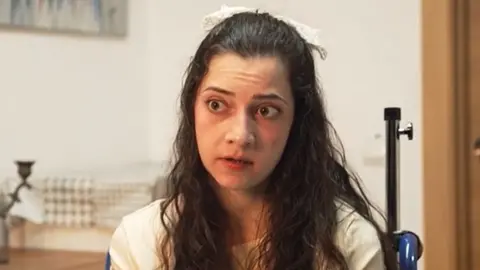
 Y Ahora Sonsoles (Atresmedia Television)
Note: This article contains mentions to sexual assault and suicide.
The passing by medically assisted death of a 25-year-old Spanish female following a protracted legal battle with her parent has sparked discussion about the responsibility of the government in caring for her and why it was so delayed to carry out her desire to die.
Noelia Castillo, who had been left paralyzed due to wounds sustained when she tried to take her own life in the year 2022, passed away on Thursday night at a Barcelona medical center.
The Catalan regional government had approved her the right to assisted dying in the year 2024.
However, the procedure was halted at the last moment following court challenges raised by her father, supported by the campaign group a Christian legal group.
The situation has garnered enormous attention in the country, with Christian Lawyers trying to block her passing until the very end.
Following an 18-month legal battle, the Strasbourg court decided this week in Noelia Castillo's favour and her death was eventually confirmed in the late hours on Thursday.
A Troubled History
Castillo had passed much of her childhood in state institutions and had described the effect on her psychological well-being of her parent's problems with drinking and of being sexually assaulted by an ex-boyfriend and also by several men in a club.
In a television appearance this week, she said no one in her immediate family had supported her decision to undergo euthanasia, and her parent "did not respect my decision and never would".
"I want to go in calm now and stop suffering," she said to a television channel the day before she died.
Her parent had not agreed with her choice but was with her at the clinic.
A former friend of Castillo, a friend, attempted to gain access to the hospital to persuade her to reconsider, but told reporters that police had prevented her from going in.
A British musician living in the country issued an appeal to Castillo via social media to think again and proposed to cover her medical costs until she felt "in a position to take this choice from a slightly more tranquil place".
Institutional Shortcomings Questioned
The legal group warned that her situation had underlined deficiencies in her support.
"For a girl who clearly has had a extremely difficult life, which we all are sorry for, the only thing that could be offered to her by the public health system is to die," said a spokesperson for the organization.
The opposition conservative party, which voted against a 2021 euthanasia law, had a comparable response.
"The institutions that should have protected Noelia let down her," wrote the party's head on an online platform. He added: "I refuse to believe that the government did not have the means to give her proper support."
In a declaration, the Church, said that her story "reflects an build-up of individual pain and institutional failures".
Legal Obstacles and Backing
However, other commentators have criticized the fact that her wishes were thwarted by court appeals put in her path by her parent and the Christian lawyers.
"The wish to bring an end to her suffering by exercising the right to assisted death was… sabotaged by a lengthy court fight that added nearly two years of pain to her existence," commented a progressive newspaper in an editorial.
A member of Congress for a left-wing platform remarked that "19 physicians have endorsed her decision and we should be respectful of it", while adding that it was a "profoundly complicated" matter.
The Country's Euthanasia Law
The nation is one of a handful of EU countries, such as the Holland, Belgium and Luxembourg, that have enacted regulations allowing euthanasia to be performed by physicians.
Under the 2021 legislation, any Spanish person over eighteen requesting euthanasia must be afflicted by an untreatable illness or "severe, long-term and incapacitating condition" and their choice must be taken free of external pressure.
The decision needs to have been expressed on two occasions in written form and has to be validated by a doctor who then consults with another doctor.
The application then goes to a Guarantee and Evaluation Commission, which has the role of assessing if the requirements have been fulfilled.
According to official data, four hundred and twenty-six requests for assisted dying were approved in 2024, the most recent period for which information is accessible. This was the initial instance that a case was taken to court for a judge to decide.


